A miR169 isoform regulates specific NF-YA targets and root architecture in Arabidopsis
Céline Sorin
Marie Declerck
Aurélie Christ

Thomas Blein
Linnan Ma
Christine Lelandais-Brière
Maria Fransiska Njo
Tom Beeckman
Martin Crespi
Caroline Hartmann
The New phytologist, Volume 202, Issue 4, June 2014, 1197—1211
Abstract
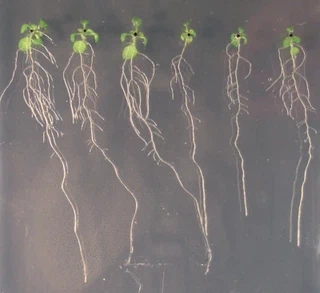
In plants, roots are essential for water and nutrient acquisition. MicroRNAs (miRNAs) regulate their target mRNAs by transcript cleavage and/or inhibition of protein translation and are known as major post-transcriptional regulators of various developmental pathways and stress responses. In Arabidopsis thaliana, four isoforms of miR169 are encoded by 14 different genes and target diverse mRNAs, encoding subunits A of the NF-Y transcription factor complex. These miRNA isoforms and their targets have previously been linked to nutrient signalling in plants. By using mimicry constructs against different isoforms of miR169 and miR-resistant versions of NF-YA genes we analysed the role of specific miR169 isoforms in root growth and branching. We identified a regulatory node involving the particular miR169defg isoform and NF-YA2 and NF-YA10 genes that acts in the control of primary root growth. The specific expression of MIM169defg constructs altered specific cell type numbers and dimensions in the root meristem. Preventing miR169defg-regulation of NF-YA2 indirectly affected laterial root initiation. We also showed that the miR169defg isoform affects NF-YA2 transcripts both at mRNA stability and translation levels. We propose that a specific miR169 isoform and the NF-YA2 target control root architecture in Arabidopsis.