Root system architecture and plant adaptation

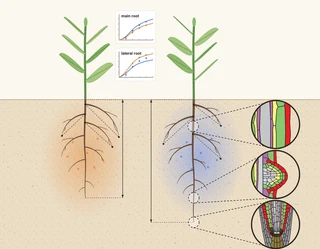
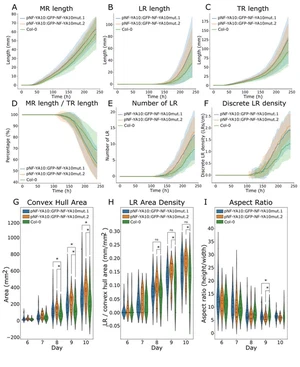
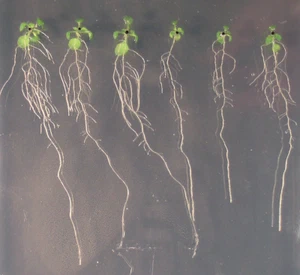
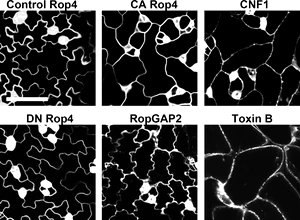
Root architecture determines how plants explore the soil for water and nutrients and how they adapt to fluctuating nutrient availability. Our work spans the control of root hair and meristem morphogenesis by Rac/Rop GTPase signalling, the miR169–NF-YA module that adjusts primary root growth and branching, and the role of NF-YA10 in lateral root angle and the area explored by the root system. We also study systemic nitrogen signalling, where the CRA2 pathway coordinates cytokinin and miR399 accumulation to repress root growth and nodulation.
Related publications
- Singh et al., 2013 — Modification of plant Rac/Rop GTPase signalling using bacterial toxin transgenes
- Sorin et al., 2014 — A miR169 isoform regulates specific NF-YA targets and root architecture in Arabidopsis
- Barrios et al., 2025 — The transcription factor NF-YA10 determines the area explored by Arabidopsis thaliana roots and directly regulates LAZY genes
- Argirò et al., 2024 — The Compact Root Architecture 2 systemic pathway is required for the repression of cytokinins and miR399 accumulation in Medicago truncatula N-limited plants
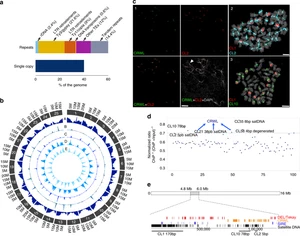
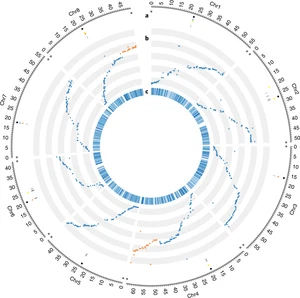
In legumes, root architecture is tightly linked to symbiotic nitrogen fixation and soil exploration. We contributed to the genome and transcriptome resources of Medicago truncatula, revealing symbiotic islands and thousands of nodule-induced lncRNAs, and to the white lupin genome, which provides a framework to study cluster-root development and phosphate acquisition.
Related publications
- Pecrix et al., 2018 — Whole-genome landscape of Medicago truncatula symbiotic genes
- Hufnagel et al., 2020 — High-quality genome sequence of white lupin provides insight into soil exploration and seed quality
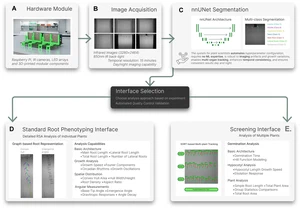
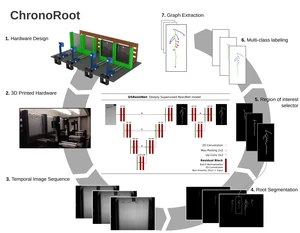
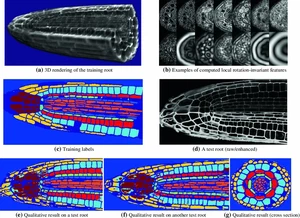
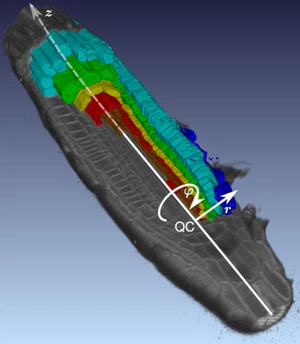
Quantifying these traits requires dedicated phenotyping and imaging approaches. We developed ChronoRoot, an open-hardware and deep-learning system for temporal root-system phenotyping, and ChronoRoot 2.0, which extends it to multi-organ segmentation and higher-throughput analysis. At the cellular scale, we use iRoCS to compare root apical meristems at single-cell resolution, and we have combined 3D imaging with pattern analysis to show how light dynamically regulates root meristem organisation. These studies are supported by image-analysis developments such as rotation-invariant HOG descriptors and attenuation correction for two-view confocal microscopy.
Related publications
- Gaggion et al., 2021 — ChronoRoot: High-throughput phenotyping by deep segmentation networks reveals novel temporal parameters of plant root system architecture
- Gaggion et al., 2026 — ChronoRoot 2.0: an open AI-powered platform for 2D temporal plant phenotyping
- Schmidt et al., 2014 — The iRoCS Toolbox — 3D analysis of the plant root apical meristem at cellular resolution
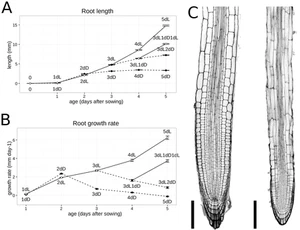
- Blein et al., 2018 — Light dynamically regulates growth rate and cellular organisation of the Arabidopsis root meristem
- Liu et al., 2014 — Rotation-invariant HOG descriptors using Fourier analysis in polar and spherical coordinates
- Schmidt et al., 2013 — Variational attenuation correction in two-view confocal microscopy
Related tags: ChronoRoot · Image analysis
Related grants


Related publications