ChronoRoot: high-throughput root phenotyping
The cultivated plants were selected mainly to improve their yield, paying less attention to environmental conditions (stress). This stress can be alleviated with treatments such as irrigation, pesticides and fertilizers. However, in order to limit the inputs required for crops, a reliable identification of tolerant varieties is necessary, in particular by studying the existing genetic variability. Phenotyping is an emerging science that characterizes the behavior of plants through the quantification of characteristics such as growth and stress tolerance.
Currently, the existing phenotyping devices use complex systems combining robotics and high-end systems, all controlled by different sensors. Thus, movements of the camera or the sample are necessary to position the sample relative to the camera. It requires very advanced engineering to limit the breakdowns and blockages that can jeopardize the whole experience. On the other hand, due to their complexity, these are expensive devices requiring dedicated premises and are therefore centralized in large platforms at national, European and international level (see IPPN network). It is difficult for small structures be able to equip themselves with an automated phenotyping device.
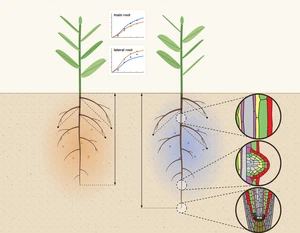
The root system is the major site of absorption of water and mineral elements necessary for the development of plants. The plasticity of root development allows plants to cope with environmental changes in the soil. The modifications of the root architecture according to environmental conditions vary enormously between species but also between ecotypes of the same species. Thus, the identification of varieties with adapted root system suited to their environment is of strong interest for breeders to develop new varieties or rootstocks for species whose optimal yield of the aerial part is accompanied by a poor root development.
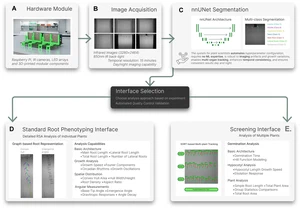
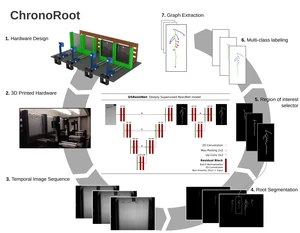
To answer this problem, we build ChronoRoot, a device for phenotyping the root system architecture (RSA) using a large number of still cameras (one per sample to follow) thus eliminating the complexity, the risk of blockage and the price of the robotic system used in other phenotyping devices. The device is made up of a set of fixed independent modules each capable of tracking a reduced number of samples for a few hundred euros. This is possible thanks to advances in consumer electronics which have allowed the price of various electronic components to fall. It is therefore now possible to easily find good resolution photo sensors for a few tens of euros. The scaling up is easily done by multiplying the number of modules. Due to the multiplication of components, a failure would affect only one small part of the experience. On the other hand, the small size and independence of the different modules allows them to be easily moved and positioned at will in any growing environment, thus removing the need to build a dedicated growing space.
This work is part of the root system architecture project.