Long non-coding RNAs as regulators of gene expression

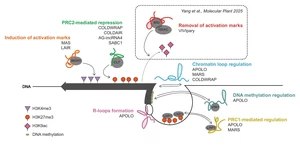
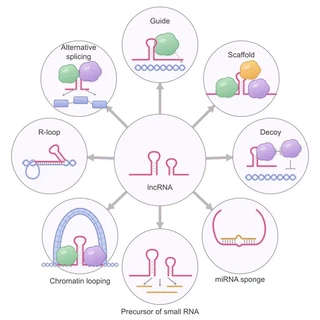 Illustration of plant lncRNA modes of action – © Thomas Blein, CC BY 4.0
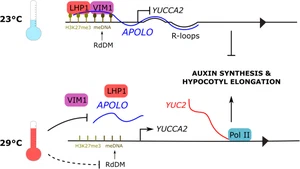
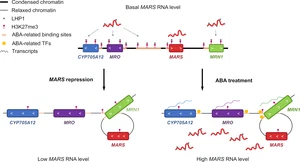
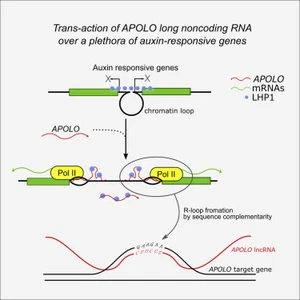
Long non-coding RNAs are emerging as versatile regulators of plant gene expression, acting at the interface between chromatin, transcription and RNA processing. We have characterised lncRNAs that control chromatin conformation and gene expression in response to developmental and environmental signals. APOLO recognises distant genomic loci through R-loop formation and decoys LHP1 to modulate chromatin loops during lateral root development; it also interacts with VIM1 and LHP1 to regulate DNA and histone methylation at YUCCA2 during thermomorphogenesis, a function shared with the sequence-unrelated human UPAT lncRNA. MARS controls the marneral biosynthetic gene cluster by titrating LHP1 in an ABA-dependent manner, promoting a chromatin loop between MRN1 and a distal enhancer, while ARES modulates lateral root architecture through its neighbouring genes.
Related publications
- Ariel et al., 2020 — R-Loop Mediated trans Action of the APOLO Long Noncoding RNA
- Fonouni-Farde et al., 2022 — The Arabidopsis APOLO and human UPAT sequence-unrelated long noncoding RNAs can modulate DNA and histone methylation machineries in plants
- Roulé et al., 2022 — The lncRNA MARS modulates the epigenetic reprogramming of the marneral cluster in response to ABA
- Roulé et al., 2023 — The long intergenic noncoding RNA ARES modulates root architecture in Arabidopsis
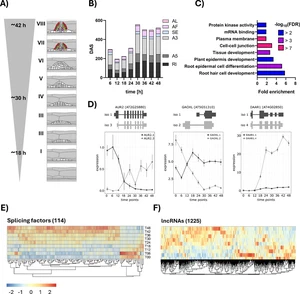
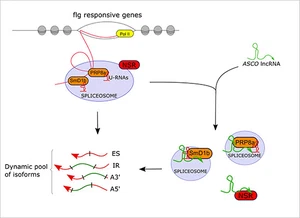
A second axis of our work concerns alternative splicing. ASCO interacts with the splicing regulators NSR and with spliceosome components such as PRP8a and SmD1b, thereby modulating the recognition of specific transcripts. More recently, we identified ACHLYS, a Brassicaceae-conserved lncRNA that interacts with NSRa and GRP7 and modulates biomolecular condensates to regulate alternative splicing during lateral root development.
Related publications
- Bazin et al., 2018 — Nuclear Speckle RNA Binding Proteins Remodel Alternative Splicing and the Non-coding Arabidopsis Transcriptome to Regulate a Cross-Talk Between Auxin and Immune Responses
- Rigo et al., 2020 — The Arabidopsis lncRNA ASCO modulates the transcriptome through interaction with splicing factors
- Heidecker et al., 2026 — The long non-coding RNA ACHLYS modulates biomolecular condensates to regulate alternative splicing in root development
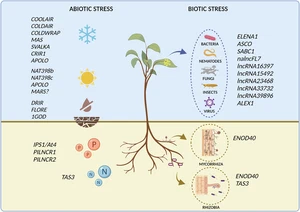
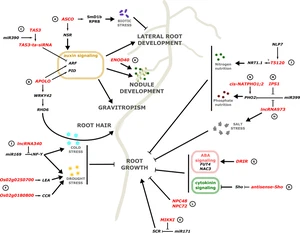
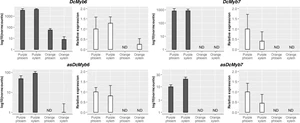
Beyond these model mechanisms, we investigate how lncRNAs contribute to specific biological processes and how their modes of action can be generalised. We identified lncRNAs associated with anthocyanin pigmentation in carrot roots, reviewed the roles of lncRNAs in root growth and development, and synthesised their contributions to environmental responses and adaptation and to chromatin regulation across plants.
Related publications
- Chialva et al., 2021 — Insights into long non-coding RNA regulation of anthocyanin carrot root pigmentation
- Roulé et al., 2022 — Regulatory long non-coding RNAs in root growth and development
- Traubenik et al., 2024 — From environmental responses to adaptation: the roles of plant lncRNAs
- Mammi et al., 2025 — From non-coding to chromatin regulators: VIVIpary and the rise of lncRNAs in plant biology
Related grants


Related publications