Conservation and evolution of lncRNAs

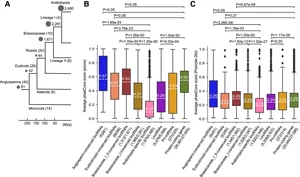
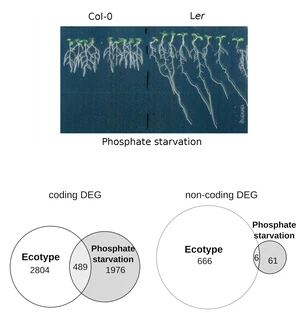
Unlike protein-coding genes, lncRNAs show limited sequence conservation, which makes orthology assignment and functional transfer difficult. We investigate alternative levels of conservation—expression, genomic position, secondary structure and function—to understand how lncRNAs evolve and contribute to plant adaptation. Comparing two Arabidopsis accessions under phosphate starvation, we found that lncRNAs are far more variable between accessions than coding genes, even when their DNA sequence is conserved, and identified ecotype-specific lncRNAs linked to root responses. At the genome-wide level, we analysed the evolutionary age, sequence conservation and transcriptional regulation of Arabidopsis lincRNAs, revealing a root-specific transcription-factor network and distinct selective pressures across lincRNA age classes.
Related publications
- Blein et al., 2020 — Landscape of the Noncoding Transcriptome Response of Two Arabidopsis Ecotypes to Phosphate Starvation
- Liu et al., 2023 — Transcription factors KANADI 1, MYB DOMAIN PROTEIN 44, and PHYTOCHROME INTERACTING FACTOR 4 regulate long intergenic noncoding RNAs expressed in Arabidopsis roots
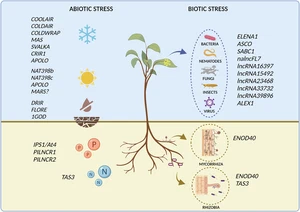
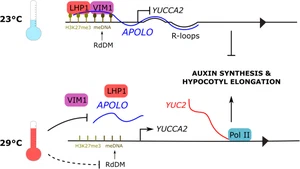
Conservation can also be functional rather than sequence-based. APOLO and the human UPAT lncRNA share neither sequence nor structure, yet both are recognised by the conserved VIM1/LHP1 machinery in plants, illustrating how lncRNA function can be preserved through conserved protein interactions. We have synthesised these findings in reviews on lncRNA conservation and on their contribution to environmental adaptation.
Related publications
- Fonouni-Farde et al., 2022 — The Arabidopsis APOLO and human UPAT sequence-unrelated long noncoding RNAs can modulate DNA and histone methylation machineries in plants
- Traubenik et al., 2024 — From environmental responses to adaptation: the roles of plant lncRNAs
More broadly, the same evolutionary question applies to other multigenic and regulatory loci. In apple, we contributed to a haplotype-resolved analysis of the S-locus showing that long-term balancing selection preserves multigenic S-haplotype architectures despite extensive structural divergence and transposable-element accumulation. This broader perspective will help us connect lncRNA evolution to the evolution of plant genomes, regulatory sequences and adaptive traits.
Related publications
- Mesnil et al., 2025 — Innovation within stability: balancing selection preserves multigenic S-haplotype architecture in apple

Related publications